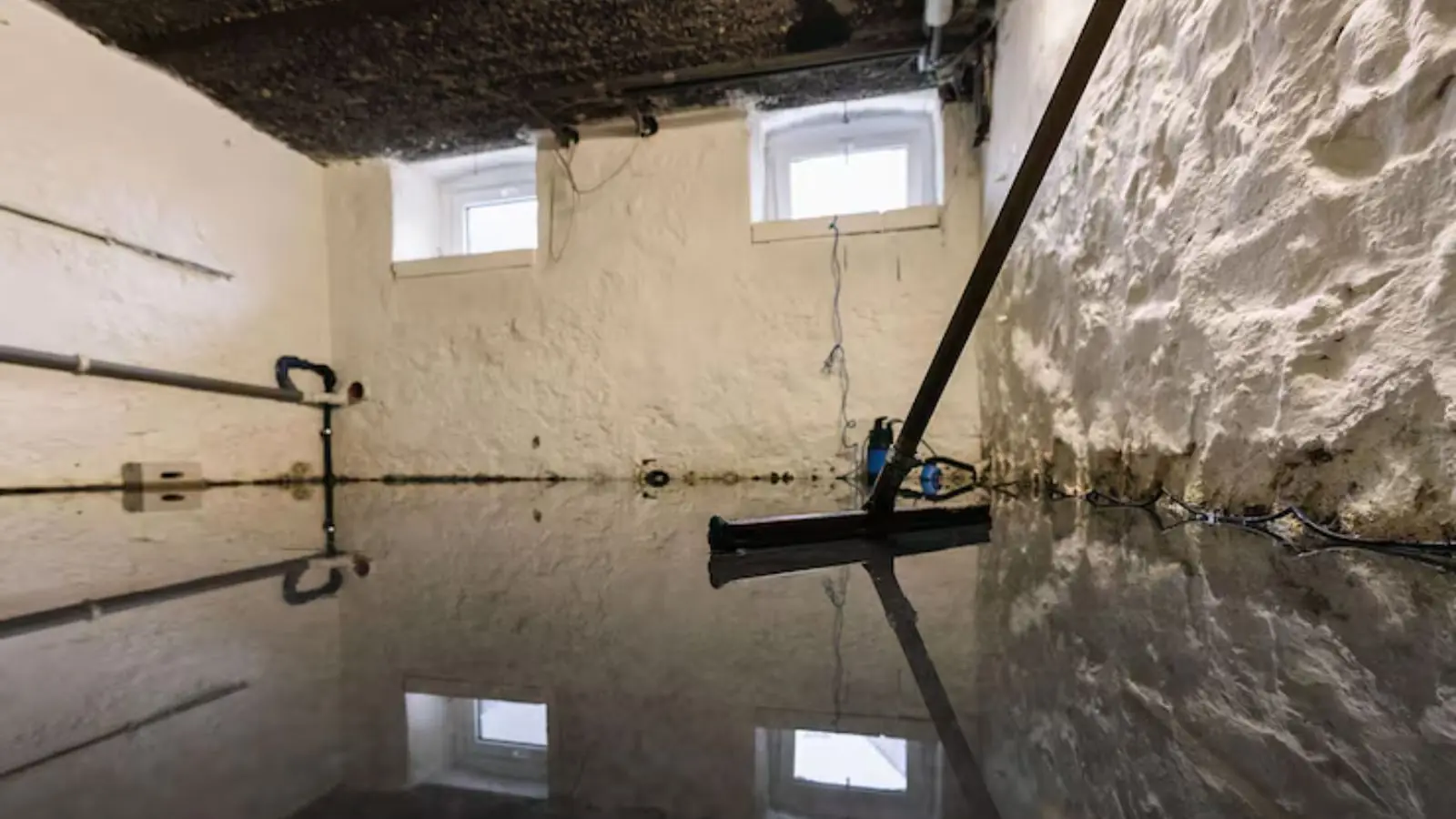
First, stay out of the water and keep people safe
If your basement took on water after heavy rain, do not walk into it until you know the power is off or the water is gone. The order is simple: protect people, stop more water if you can, get the standing water out, then dry and clean what is left.
Treat the water as contaminated. The CDC says floodwater can contain dangerous bacteria from overflowing sewage, so skip bare hands, bare feet and casual wading. Heavy rain water that has run across streets and through drains is not the same as a clean pipe leak.
Stored boxes, carpet, drywall and furniture soak up that water quickly. The EPA advises drying water-damaged areas and items within 24 to 48 hours to prevent mold growth, so the clock starts early.
Electricity and gas come before cleanup
Do these before you touch anything wet
Water and electricity do not mix, and a basement is where panels, outlets, water heaters and furnaces often sit. If water is near any of them, stay out.
- Cut power at the main only if the panel is dry and you can reach it without stepping in water. If not, call your electric utility or 911 from outside.
- If you smell gas, leave the building and call 911 and the gas company from outside. The Washington Gas leak line is 844-927-4427, option 1.
- Do not run a wet-dry vacuum, space heater or extension cord in a wet basement.
- Keep children and pets out of the water, and do not use bleach in a closed space. The CDC says never to mix bleach with ammonia or other cleansers.
What comes out and what can stay
Sorting takes judgment, and floodwater tilts it toward removal. These are general guidelines, and a crew with moisture meters can narrow them for your house.
Carpet and pad
Pad acts like a sponge and rarely survives floodwater. Carpet may be saved only if the water was clean and it is lifted quickly.
Drywall and insulation
Wet drywall wicks water up the wall, and wet insulation traps it in the cavity. Crews often cut the wall open above the wet line to dry the framing.
Concrete and masonry
Concrete floors and block walls usually stay. They are cleaned, sanitized and dried with air movers and dehumidifiers.
Furniture and boxes
Solid hard-surface items can often be cleaned. Cardboard, upholstered pieces and particleboard usually cannot.
Appliances and mechanicals
Have a licensed professional look at a furnace, water heater or panel that sat in water before it is powered up again.
Hyattsville, MD: why a downpour can flood a basement here
The city's own Lower Ward 1 Resilient Stormwater Systems Study, completed between 2018 and 2020, says 41st Street experiences standing water during and after intense rain. It also notes that frequent downpours in 2018, the wettest year on record for the Washington, DC area, spurred multiple flood events.
To calibrate its model, the study used two storms: August 2014, with 2.96 inches over about 5.5 hours, and July 2017, with 4.21 inches over about 15 hours. It says much of the storm drain system dates from 1960 to 1990. For a homeowner, that means a basement near a low street or a clogged inlet can flood in a downpour even if no river overflows.
Prince George's County's flood history page lists Tropical Storm Agnes in June 1972 as the county's storm of record and names the Green Meadows subdivision in Hyattsville among the hardest hit. It also lists localized flooding from Hurricane Isabel in September 2003, plus heavy rain and flooding in June 2006 and May 2008.
Basement still holding water?
Call (301) 936-0619 to reach the 24/7 line for pumping, removal and drying.
Pumping out and where the water goes
Extraction units and submersible pumps remove standing water far faster than buckets or a household shop vac. After the bulk is out, air movers and LGR dehumidifiers take over, and thermal imaging cameras help find wet spots behind walls.
If you run a sump pump, the city's resident brochure says the water must not be directed onto a neighboring property or over the public right of way. Point the discharge hose where it will not run onto your neighbor's lot or the sidewalk and street.
Flood damage restoration adds cleaning and sanitizing on top of drying, since the water carried street runoff and possibly sewage. If water is still rising, emergency water removal is the first stage, before any rebuilding.
Maps, policies and paperwork
Check the FEMA flood map for your address at msc.fema.gov. The FEMA Map Service Center lets you search by address and shows the effective map panel. The city's stormwater study also notes that a Hyattsville-Riverdale levee system protects some areas from the 100-year flood, which is one reason a map lookup is worth doing.
On insurance, the Maryland Insurance Administration says most homeowners policies do not cover flooding. Sewer or water backup is an optional endorsement that insurers must offer. FEMA says a flood policy through the NFIP generally has a 30-day waiting period before it takes effect, so it cannot be bought after a storm is already coming.
Photograph everything before you move it, keep damaged items until your insurer says otherwise, and read your policy or ask your insurer what applies. Maryland's claim practices rule, COMAR 31.15.07.03, lists failing to acknowledge a claim within 15 working days as an unfair practice, with exceptions.
The first day, in order
Once the power and gas questions are settled, work through the following in sequence.
- Photograph the water line on walls and the items affected, before anything is moved.
- Lift anything valuable off the floor and carry out what can be saved, wearing waterproof boots and gloves.
- Get standing water out with pumps or an extraction unit, then open the space to air.
- Remove soaked carpet and pad, which hold contaminated water and slow drying for everything around them.
- Call the 24/7 line the same day, since drying equipment is most useful early.
Getting help in the towns around the city
The levee system noted in the city's study is shared with Riverdale Park, the town just to the north. The 24/7 line serves it and nearby towns such as Brentwood as well as Hyattsville.
After the water is out, water damage cleanup covers the cleaning, drying and tear-out that follow. Scope and price are explained before work starts.
Frequently asked questions
Not until the power question is settled. If the water is near outlets, a panel or appliances, stay out and call your electric utility or 911 from outside. Even with power off, treat the water as contaminated.
Only for a very small, clean spill. Anything deeper, or any water that came from outside, needs pumps, extraction and dehumidification, and it carries contamination concerns that fans do not solve.
The EPA advises drying water-damaged areas and items within 24 to 48 hours to prevent mold growth. Start by getting standing water out, then dry the materials that remain.
Usually not for flooding. The Maryland Insurance Administration says most homeowners policies do not cover flood, and sewer or water backup is an optional endorsement. Check your policy and ask your insurer.
The city's resident brochure says sump pump water must not be directed onto a neighboring property or over the public right of way. Ask the city's Code Compliance office if you are unsure where your discharge should go.